
Cabinet Painting & Refinishing in Raleigh, NC
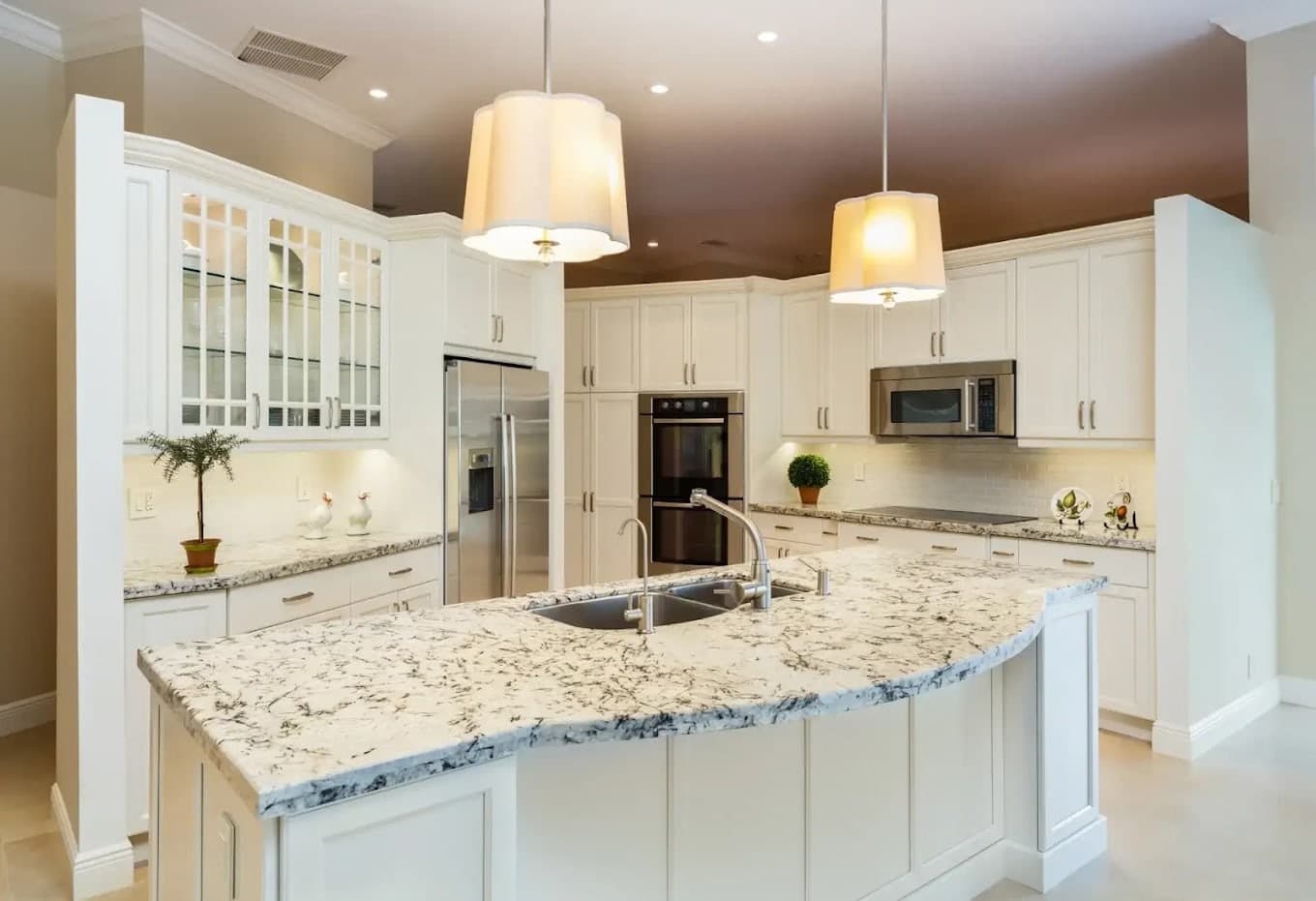
Refinishing cabinets changes a kitchen more than almost anything else you can do for the money. Done properly it looks sprayed, not brushed — no visible strokes, no tacky finish, and doors that still close cleanly.

How we work
- 01
Assess
We check the cabinet material and condition — not every surface takes paint the same way, and we'll tell you honestly if yours is a poor candidate.
- 02
Strip and clean
Doors and drawer fronts come off and get labelled. Everything is degreased, because kitchen grease is what makes cabinet paint fail.
- 03
Sand and prime
Scuff-sanded and coated with a bonding primer so the finish actually adheres to the surface.
- 04
Spray
Sprayed in controlled conditions for a smooth finish with no brush marks.
- 05
Cure and refit
Given proper cure time before hardware goes back on and doors are rehung.
Refinishing versus replacing, honestly
The case for refinishing is straightforward: in most Triangle kitchens built from the mid-1990s onward, the cabinet boxes are sound plywood or dense MDF, the layout works, and the only thing dating the room is the colour and sheen of the doors. Refinishing gets you most of the visual change of a new kitchen for a fraction of the cost and a fraction of the disruption, and it does not put a skip in your drive for a fortnight.
The case against it is equally straightforward, and we will make it when it applies. If the boxes are delaminating, if particle board has swollen from a long-term leak under the sink, if the hinges have torn out of the stiles, or — most commonly — if the layout is the actual problem, then paint is money spent on the wrong thing. A beautifully refinished kitchen with the fridge still in the wrong place is a beautifully refinished kitchen you still do not like.
Thermofoil is the other honest no. Those are MDF doors wrapped in a heat-fused vinyl film, common in kitchens of a certain era, and once that film starts lifting at the edges near the oven there is no preparation that makes paint stick reliably to it. We would rather tell you that at the walkthrough than take the job.
Degreasing is the step that decides everything
If you remember one thing about cabinet painting, make it this: cabinet finishes fail because of grease, not because of paint.
A kitchen deposits an invisible film of aerosolised cooking oil on every surface within reach of the hob, and years of it accumulate most heavily on the doors either side of the range and the cabinet fronts directly above it. It cannot be seen and it can barely be felt. Sand over it and you drive it into the substrate. Prime over it and the primer bonds to the grease film rather than the wood, which is exactly as strong as the grease film — which is to say, not at all.
So everything gets degreased with a proper cleaner before a single abrasive touches it. It is the least visible step in the entire process and it is the one that determines whether your doors still look right in five years. When you get a cabinet quote that is dramatically cheaper than the others, this is very often what is missing from it.
Sanding, bonding primer and why we spray
After degreasing, every surface gets scuff-sanded. The purpose is not to remove the old finish — on a factory-lacquered door that would take days — but to break the sheen so the primer has mechanical grip in addition to chemical adhesion.
Then a bonding primer, which is a genuinely different product from a general-purpose one. It is formulated to grab slick, previously finished surfaces that ordinary primer slides off. On factory-finished cabinetry it is not optional.
The finish is sprayed, not brushed, and this is the part you can see. A brushed cabinet door has stroke marks in it; they catch side light and they announce themselves for the life of the finish. A sprayed door has an even, factory-smooth film with no texture. Getting there means doors and drawer fronts come off, get labelled so every one returns to the opening it came from, and are sprayed flat in controlled conditions where dust and overspray are managed. The boxes and face frames are done in place with the kitchen fully masked.
Cure time is not dry time
This is the expectation most worth setting before the job starts, because it is where disappointment usually comes from.
A cabinet coating is dry to the touch within hours and fully cured in considerably longer — depending on the product and on how humid the week is, meaningful hardness can take a couple of weeks to develop. During that window the film is soft. Stacking heavy crockery on a shelf, slamming a door against its stop, or taping something to a fresh face can mark a finish that will be genuinely tough once it has hardened.
So we hang doors when they are ready to be handled and tell you plainly what to be gentle with, and for how long. Anyone promising a fully hardened kitchen the day they leave is describing something the chemistry does not do.
The practical version: your kitchen stays usable throughout — the sink, the appliances and the worktops are never out of action for the duration. It is the doors and drawer fronts that are away, and we sequence that so you are not living out of boxes.
Hardware, hinges and the details that date a kitchen
Hardware comes off rather than getting taped around. Painting up to a taped edge leaves a ridge, and paint that creeps under tape onto a hinge leaf stops it closing properly.
It is also the cheapest upgrade available in the whole project. If your doors are coming off anyway, swapping dated brass knobs for something current adds very little to the job and changes the read of the kitchen almost as much as the colour does. Existing holes usually dictate what fits, so bring that up at the estimate and we will tell you what your hole spacing allows.
Hinges are worth a look while everything is apart. Old surface-mount hinges are one of the strongest era signals in a kitchen. Whether they can be swapped for concealed hinges depends on how the doors are bored, which we can tell you once one is off.
We take cabinet painting & refinishing work across the Triangle — cabinet painting & refinishing in Raleigh, cabinet painting & refinishing in Cary, cabinet painting & refinishing in Apex, cabinet painting & refinishing in Holly Springs, cabinet painting & refinishing in Fuquay-Varina, cabinet painting & refinishing in Wake Forest and cabinet painting & refinishing in Durham. Each of those pages covers what we actually see in that town’s housing.
Cabinet Painting & Refinishing questions
Is painting cabinets worth it versus replacing them?
If the boxes are sound and you like the layout, refinishing gets you most of the visual change for a fraction of the cost and disruption. If the boxes are failing or the layout doesn't work, replacement is the better spend — and we'll say so.
How long is my kitchen out of action?
Doors and drawer fronts are off for part of the project, and the finish needs cure time before heavy use. We'll give you a realistic timeline up front so you can plan around it.
Will it chip?
Preparation is what decides that. Degreasing, scuff-sanding and a bonding primer are why a cabinet finish holds up — skipping them is why some don't.
LET’S GET TO WORK.
A free estimate. A clear scope. An owner who sees it through.