
Deck & Fence Staining in Raleigh, NC
Wood outdoors in North Carolina takes sun, rain and humidity year round. Cleaning, repairing and sealing it properly is the difference between a deck you enjoy and one you replace.

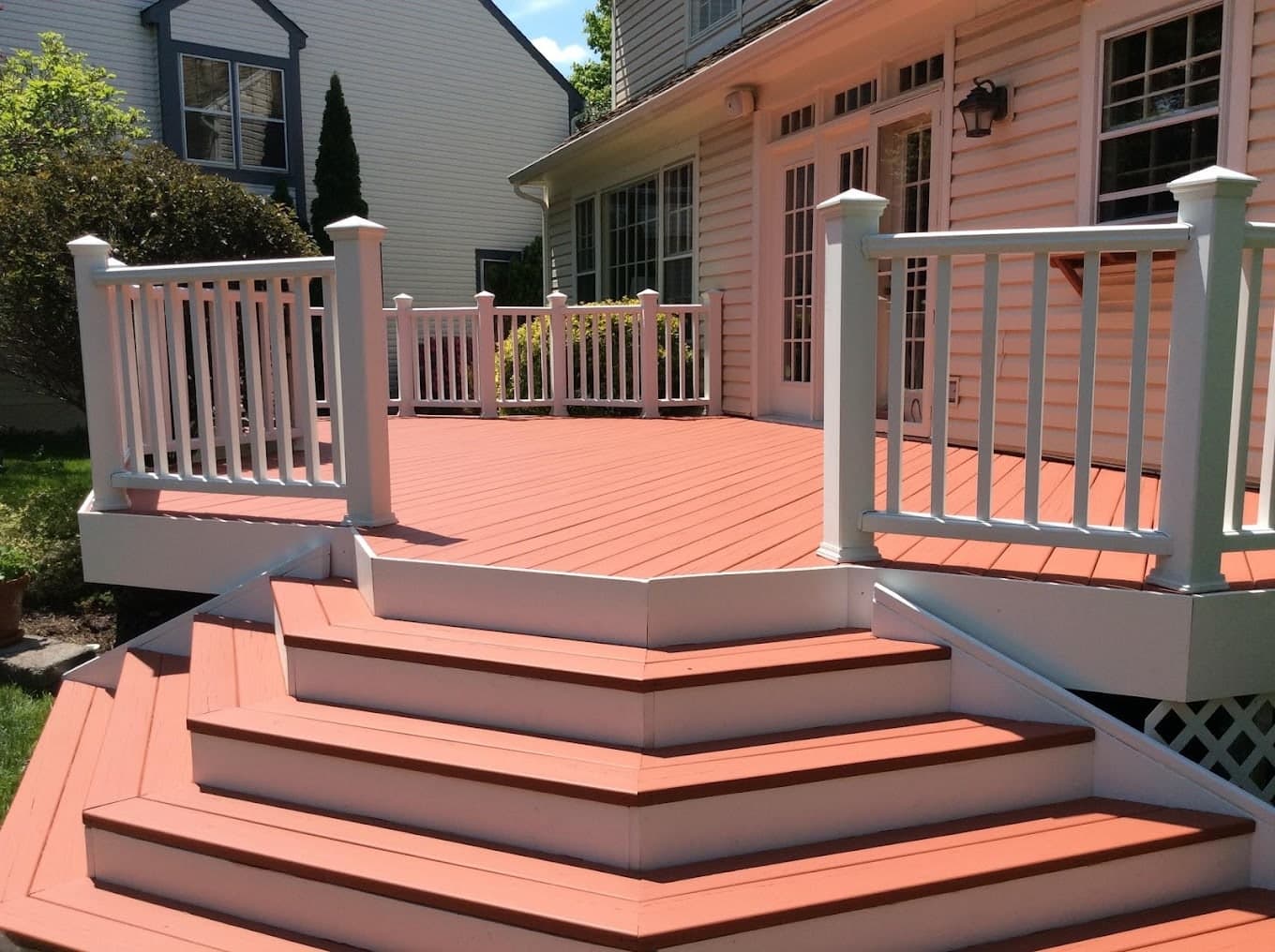
How we work
- 01
Inspect
We check boards, railings and fixings, and tell you what needs replacing before any stain goes down.
- 02
Clean
Pressure washing to strip grey weathered fibre, mildew and old failing finish.
- 03
Repair
Damaged boards and loose railings sorted before staining, not after.
- 04
Stain and seal
Applied when the wood is properly dry, so it absorbs instead of sitting on the surface.
What the grey actually is
The single most common question about a weathered deck is whether it is ruined. Almost always, no.
The silver-grey surface of untreated or long-unmaintained exterior wood is UV-degraded lignin — the binder between the wood fibres — breaking down in the top fraction of a millimetre. Beneath it the wood is usually perfectly sound. Cleaning removes that degraded fibre and takes the boards back to something close to their original colour, which is why a properly washed deck looks shockingly different before any stain goes near it.
What cleaning cannot fix is structural. Boards that are soft when you press a screwdriver into them, joists showing rot where they meet the ledger, and railings that move when you lean on them are replacement items, not staining items. We check those first and tell you what needs doing. Staining over a failing deck buys you one good-looking season and no more.
The drying window is the whole job
Here is the mistake that ruins more deck refinishes in North Carolina than any other: staining wood that is not dry.
Stain works by penetrating. Wood saturated with wash water has no capacity left to absorb anything, so the stain sits on the surface as a film instead of soaking in, and a film that was never meant to be a film fails within a season — blotching, peeling, and looking worse than the bare wood did.
After pressure washing, decking needs real drying time before stain. In Triangle humidity that is typically a couple of days of decent weather, sometimes more after a wet stretch, and shaded north-facing sections take longer than the sunny middle of the deck. Pressure-treated lumber that is new from the yard is a longer wait again, because it arrives wet with treatment chemicals and can need months before it will take stain properly.
This is why deck work comes back on a second visit rather than getting done in a day. Anyone offering to wash and stain your deck in one visit is either not washing it properly or not letting it dry.
Transparent, semi-transparent or solid
The choice of stain type sets the whole maintenance cycle, and it is worth understanding before you pick a colour.
Transparent and semi-transparent stains let the grain show, which is what most people want on a deck they like the look of. They penetrate rather than forming a surface film, so when they wear they fade evenly rather than peeling. That makes reapplication straightforward — clean and recoat, no stripping. The trade-off is frequency: on a full-sun Triangle deck, expect to be back at it every couple of years.
Solid stains behave more like paint. They obscure the grain, they last considerably longer, and they are the sensible answer for old wood that has weathered unevenly or been previously coated with something solid. The trade-off is that a solid film eventually peels rather than fading, and when it does, the next refinish involves stripping rather than just cleaning. Choosing solid is choosing an easier decade and a harder day at the end of it.
Horizontal surfaces and vertical surfaces do not wear alike. Deck boards take standing water, foot traffic and direct overhead sun; railings and fence boards take far less. It is entirely reasonable for the floor to need attention twice as often as the rails, and worth planning for rather than discovering.
Fences, and why they are their own job
Fencing looks like a simpler version of deck work and behaves differently in two ways.
First, the volume of surface is deceptive. A fence has two faces, and the pickets have edges — the real square footage on a run of privacy fence is far higher than the length suggests. Second, the bottom of a fence lives a hard life: splashback from soil, permanently damp ground contact, and whatever the irrigation system does to it every morning. That bottom band is where fences fail, and it needs particular attention rather than a uniform pass.
Fences also sit on boundaries, which occasionally makes them a conversation with a neighbour before it is a conversation with us. Worth checking who owns it before you commit to a colour.
Screened porches, pergolas and outdoor furniture
Anything wooden and outdoors is fair game, and the covered structures are often better candidates than people expect.
A screened porch is protected from direct rain but not from humidity, and the ceiling and upper trim are usually the last surfaces in the house to get any attention. They also tend to be bead-board, which is brush and spray work rather than roller work. Pergolas take full unshaded UV on their top surfaces and almost none underneath, so they weather more unevenly than anything else on a property.
Outdoor furniture is worth mentioning at the estimate if you have wooden pieces you like. It is small work, it happens while the deck is drying anyway, and it is far cheaper than replacing a table you already own.
We take deck & fence staining work across the Triangle — deck & fence staining in Raleigh, deck & fence staining in Cary, deck & fence staining in Apex, deck & fence staining in Holly Springs, deck & fence staining in Fuquay-Varina, deck & fence staining in Wake Forest and deck & fence staining in Durham. Each of those pages covers what we actually see in that town’s housing.
Deck & Fence Staining questions
Can an old grey deck be brought back?
Usually, yes. Most of what looks like permanent greying is weathered surface fibre that comes off with proper cleaning. We'll tell you honestly if boards are too far gone to save.
Do you repair as well as stain?
Yes. Loose railings and damaged boards get dealt with first — staining over a failing deck just hides the problem for a season.
LET’S GET TO WORK.
A free estimate. A clear scope. An owner who sees it through.